Gel Documentation System
Clear gel images are essential when documenting DNA, RNA, or protein separation results. In routine molecular biology work, a reliable Gel Documentation System helps laboratories capture bands consistently, compare experiments more efficiently, and support traceable reporting for research, teaching, and quality-controlled workflows.
This category focuses on imaging systems and related tools used after electrophoresis, especially where users need dependable visualization, image capture, and analysis support. Whether the requirement is a compact portable unit or a bench system with a UV or blue LED transilluminator, the goal is the same: obtain readable gel images without making documentation a bottleneck in the lab.
What a gel documentation system is used for
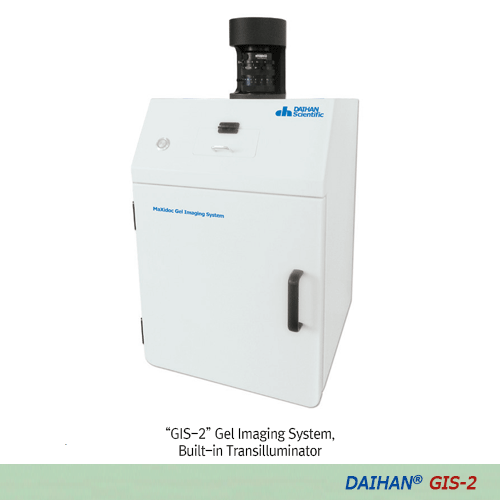
A gel documentation system is designed to capture and record images of electrophoresis gels after separation. In practical lab use, this typically means photographing stained nucleic acid or protein bands under controlled illumination so the image can be stored, reviewed, printed, or analyzed later.
Compared with improvised imaging methods, a dedicated system improves repeatability and user convenience. It brings together controlled lighting, an imaging chamber or capture setup, and software or accessories that support routine documentation. This is especially valuable when multiple users need a standardized process across the same laboratory.
Common configurations in this category
One of the main differences between systems in this range is the type of transilluminator provided. The available DaiHan configurations include both UV transilluminator and blue LED transilluminator versions, allowing labs to align the imaging setup with their staining method, workflow preference, and handling requirements.
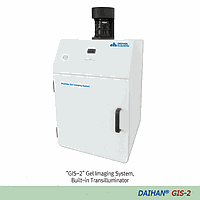
For example, the DaiHan DH.WGD00300 and DH.WGD00301 Gel Doc. System Gis-2 are listed with UV transilluminators in 230V and 120V versions, while the DH.WGD00310 and DH.WGD00311 variants use blue LED transilluminators in corresponding voltage options. This makes it easier to choose a system based not only on detection method, but also on site power requirements.
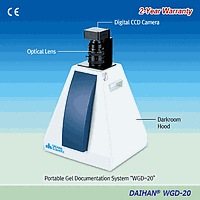
For users who need a more compact setup, portable options such as the DaiHan DH.WGD00020 WGD-20 and DH.WGD00024 WGD-20S can fit applications where bench space is limited or a lighter imaging solution is preferred.
How to choose the right system for your lab
The most practical starting point is to review how gels are actually processed in your lab. If users work with established UV-based workflows, a UV-equipped system may fit existing practice. If the lab prefers an alternative illumination approach, a blue LED model may be more suitable. In either case, image quality, workflow simplicity, and operator consistency matter more than choosing on model name alone.
Next, consider throughput and deployment. A portable system can be useful for flexible or lower-volume tasks, while a more integrated benchtop setup may be preferable for routine documentation in a fixed location. Voltage is also a straightforward but important selection point, especially for multi-site buyers or international facilities ordering either 120V or 230V equipment.
If your team is already evaluating broader equipment from DaiHan, it may be helpful to compare this category with other DaiHan laboratory products to build a more consistent bench setup.
Software and accessories in the imaging workflow
A gel documentation workflow often extends beyond the imaging unit itself. This category also includes supporting items such as the DaiHan DH.WGD00100 Software DNA Analysis TotalLabTM Phoretix 1D and the DH.WGD00121 Software DNA Analysis Phoretix 1D Pro, which are relevant when users need image review or downstream band analysis support.
Accessories can also play a practical role in deployment. The DaiHan DH.WGD00200 Computer LapTop for WGD Gel Doc.System illustrates how some setups are supported by dedicated companion hardware rather than being treated as standalone camera boxes. In purchasing terms, this matters because labs often need a complete documentation workflow, not just the core imaging chamber.
Typical applications in laboratory environments
These systems are commonly used in molecular biology, biotechnology, life science teaching labs, and similar environments where electrophoresis is part of routine work. Typical tasks include documenting agarose or similar gels after sample separation, preserving image records for comparison, and organizing visual data for reports or further interpretation.
In many labs, the documentation step is closely connected to sample preparation, heating, and other bench procedures. Depending on the wider workflow, users may also explore related laboratory tools such as blending equipment for sample handling or burners and torches for adjacent lab processes where appropriate. These are not substitutes for gel imaging, but they can be part of the same operational environment.
Why illumination type and portability matter
When comparing systems, illumination type affects how gels are viewed and how the imaging step is carried out. A system built around UV illumination may align well with established protocols, while a blue LED configuration may be preferred where users want a different light source in the documentation process. Selection should be based on workflow compatibility rather than assumptions about one format serving every application.
Portable systems are worth considering when the lab needs easier relocation, simpler deployment, or a smaller footprint. By contrast, a larger fixed unit may suit shared instrument rooms or routine teaching and testing areas where multiple users document gels in a standard location throughout the day.
Planning a practical purchase decision
For B2B buyers, the most useful comparison usually comes down to four points: illumination type, portability, software needs, and local power standard. Once those are clear, it becomes easier to narrow the choice between portable WGD-series options and Gis-2 systems with either UV or blue LED transilluminators.
It is also helpful to think in terms of the full lab process. A system that matches existing electrophoresis practice, available workspace, and documentation needs will usually provide better long-term value than selecting only by initial configuration. For teams standardizing multiple benches or educational labs, consistency in operation and training can be just as important as the imaging hardware itself.
Final thoughts
This category brings together gel imaging systems, software, and supporting components for laboratories that need dependable electrophoresis documentation. From portable DaiHan WGD models to Gis-2 systems with UV or blue LED transilluminators, the selection is suited to labs looking for a practical balance between image capture, workflow fit, and day-to-day usability.
If you are comparing options for a new installation or replacing older imaging equipment, focus on how the system will be used in real bench conditions. The right choice is the one that supports clear image capture, straightforward operation, and a documentation process your team can use consistently.
Get exclusive volume discounts, bulk pricing updates, and new product alerts delivered directly to your inbox.
By subscribing, you agree to our Terms of Service and Privacy Policy.
Direct access to our certified experts