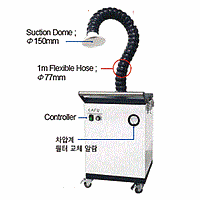
Gas Purifier
Air quality control is a practical requirement in many laboratories, pilot plants, and chemical handling areas where fumes, VOCs, acids, odors, or fine particles can affect both safety and process reliability. A well-matched Gas Purifier helps capture contaminants close to the source, reduce operator exposure, and support cleaner working conditions in spaces where conventional ventilation alone may not be enough.
In this category, you can find gas purification equipment designed for different laboratory scenarios, from portable local extraction units to room-wide toxic gas purification systems and dedicated solutions for hazardous storage. The product range also includes integrated systems intended for specific gas-handling workflows, giving buyers options based on installation space, contaminant type, and required airflow.
Where gas purifiers are used in laboratory environments
Gas purifiers are commonly selected for applications where airborne contaminants are generated intermittently or continuously during handling, transfer, storage, or testing. Typical use cases include benchtop chemical work, localized fume capture, storage cabinet exhaust support, and room air treatment in spaces where toxic or odorous gases may accumulate.
Compared with general-purpose ventilation, a dedicated purifier is often chosen when the goal is more targeted control. Depending on the setup, the unit may be positioned near the source, connected to a cabinet or enclosed space, or used as a standalone device for broader environmental treatment. In laboratory workflows, this can complement other safety tools such as protective lab apparels and controlled handling practices.
Common contaminant types and filtration approach
The products in this category are intended for contaminants such as toxic gases, organics including VOCs, acids, odors, dust, and in some cases bacteria or fine fumes. In practice, the filtration strategy depends on the contaminant profile. Fine particulate matter is typically addressed with prefilters or fiber bag filters, while gaseous pollutants may require multi-layer chemical filtration media designed for adsorption or neutralization.
Several listed models also combine particulate and gas-phase treatment in a single unit. This is useful in laboratory operations where a process may generate mixed emissions rather than a single pollutant type. When evaluating a gas purifier, it is important to consider not only filtration efficiency claims, but also whether the filter structure matches the actual chemical load and expected replacement interval.
Portable gas purifiers for local source capture
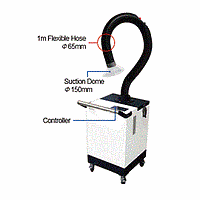
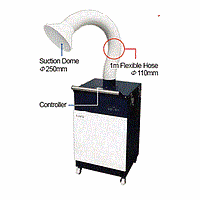
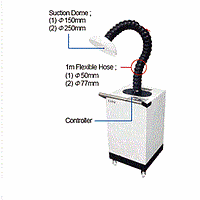
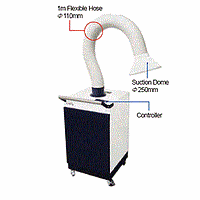
Portable units are often the most flexible choice when contaminants are generated at a bench, near a small reactor, or at a temporary work position. They can be moved closer to the emission point and paired with a suction dome or flexible hose to improve capture before fumes spread into the room. This approach is especially relevant when layout changes are frequent or when fixed ducting is not practical.
DaiHan offers several portable filtering toxic gas multi-purifiers in this category, including models such as CAFU-21, CAFU-A02, CAFU-A13, CAFU-A14, and CAFU-A19. These examples show a range of airflow capacities and filter configurations for handling combinations of dust, VOCs, acids, odors, and bacteria. Lower-capacity units may fit compact bench applications, while higher-airflow versions are more suitable when capture distance is greater or contaminant generation is heavier.
TOGA also provides portable toxic gas purification options such as the TOGA-M01D. For buyers comparing formats, the key distinction is usually not just size, but how the unit integrates into the workflow: direct local extraction, mobile deployment between workstations, or use as a support device around chemical handling zones.
Solutions for hazardous storage and enclosed systems
Not all gas purification needs come from active experiments. Chemical storage areas can also release vapors over time, especially when reagents are frequently accessed or when trace fugitive emissions build up inside enclosed cabinets. In these cases, a purifier designed for hazardous storage can be a more appropriate choice than a general portable extractor.
Examples in this category include the TOGA-SCDOP and TOGA-SCAOP, both positioned as toxic gas purifiers for hazardous storage applications. These types of devices are relevant when connecting purification hardware to storage infrastructure, helping manage chemical vapors at the cabinet level rather than waiting for contaminants to disperse into the room. They are often considered alongside broader laboratory handling equipment such as carts and trolleys used for controlled movement of materials.
Room-wide purification and integrated systems
Some laboratories require gas control beyond a single workstation. If the risk is distributed across a room, or if multiple handling points contribute to background contamination, a room-wide purification unit may be more suitable. These systems are selected to improve overall air treatment across a defined area rather than focusing only on one source point.
TOGA models such as the TOGA-S02D and TOGA-S02AI are examples of toxic gas purifiers intended for broader room use. The category also includes all-in-one osmium gas purification systems such as TOGA-SVS01 and TOGA-SVE01, which combine enclosure-related elements with purification functionality. For users working with heat or combustion-related lab processes, it may also be useful to review related equipment such as burner and torch products to assess the wider operating environment.
How to choose the right gas purifier
A practical selection process starts with the emission source. If contaminants are generated at a known point, source capture with a portable unit and hose assembly is often the most efficient route. If the concern is storage vapor, cabinet-connected purification may be more suitable. If the issue is ambient buildup across the workspace, a larger standalone purifier designed for room coverage will usually make more sense.
The next step is to compare airflow and filter configuration with the actual application. Higher suction capacity can improve capture performance, but airflow alone does not guarantee suitability if the filter media is not matched to the gases involved. Buyers should also review noise level, electrical requirements, available control interface, maintenance access, and realistic filter replacement intervals based on usage intensity.
Finally, installation and daily operation should not be overlooked. Consider available footprint, whether mobility is required, the position of the suction point, and how easily filters can be monitored or replaced. For teams already familiar with the manufacturer ecosystem, browsing additional DaiHan laboratory products can also help maintain consistency in service, operation, and procurement.
Why filter maintenance matters
The long-term performance of a gas purifier depends heavily on maintenance discipline. Even when a unit has a strong nominal filtration specification, real-world performance will decline if prefilters are clogged, gas-phase media is saturated, or replacement timing is delayed beyond the recommended cycle. In laboratory environments, this can lead to reduced capture efficiency, more odor breakthrough, and higher exposure risk.
That is why replacement guidance in the listed products is more than a routine service note. Some models indicate scheduled changes after a certain number of hours or months, while others use sensor-based alerts. For procurement teams and lab managers, maintenance planning should be part of the initial selection decision, especially when the purifier will be used for variable contaminant loads or continuous operation.
Finding a suitable system for your process
This category brings together gas purifiers for local extraction, storage-area protection, and wider room treatment, making it easier to compare equipment by application rather than by product name alone. Whether the requirement is compact bench-level capture, support for chemical storage safety, or an integrated toxic gas management setup, the right choice depends on how contaminants are generated and where control is most effective.
When comparing models, focus on the relationship between airflow, filtration structure, intended installation method, and maintenance cycle. That approach will usually lead to a more reliable and practical purchasing decision than simply choosing the largest unit or the most complex control panel.
Get exclusive volume discounts, bulk pricing updates, and new product alerts delivered directly to your inbox.
By subscribing, you agree to our Terms of Service and Privacy Policy.
Direct access to our certified experts