Industrial Test & Measurement
Reliable measurement is a foundation of modern production, maintenance, and quality control. Whether the task involves dimensional inspection, process verification, or routine troubleshooting, the right instruments help teams reduce rework, improve consistency, and make faster technical decisions across the shop floor.
Industrial Test & Measurement covers a broad set of tools used to check accuracy, monitor equipment behavior, and verify whether parts or processes stay within required tolerances. In industrial environments, these products are not only used by metrology teams, but also by maintenance engineers, machine builders, automation integrators, and QA departments that need dependable data for everyday work.

Why test and measurement matters in industrial environments
In industrial settings, small deviations can create larger downstream problems. A dimension that drifts outside tolerance, an unstable process parameter, or an incorrect machine setup can affect product quality, equipment performance, and delivery timelines. Measurement tools help identify these issues early, before they become costly production problems.
This is especially important in applications where repeatability and traceability are part of normal operations. From incoming inspection to in-process checks and final verification, measurement accuracy supports better control of both products and processes. It also helps teams document results more clearly when working with internal standards or customer-specific requirements.
Typical applications across production, maintenance, and QA
Products in this category are commonly used wherever technical values need to be checked rather than assumed. In manufacturing, that may include dimensional inspection of machined parts, checking setup conditions during changeovers, or validating critical measurements during assembly. In maintenance, test instruments support condition checks, diagnostics, and routine service work.
Quality teams also depend on suitable measuring equipment to compare actual values with design intent. In many workflows, this category works alongside automation components and control systems. For example, measured results may inform machine adjustments, while data from related equipment such as industrial controllers helps maintain process stability after verification.
What to look for when selecting industrial measuring equipment
The right choice depends on the measurement task first, not just on the device format. Buyers should consider the type of parameter being checked, the required tolerance band, the measuring range, the resolution needed for decision-making, and the working conditions around the point of use. A tool suitable for bench inspection may not be ideal for use near a production line, and vice versa.
It is also useful to evaluate how the instrument will fit into the wider workflow. Important factors often include repeatability, ease of zero setting, compatibility with probes or accessories, and how quickly operators can perform routine checks. In environments where measurements support machine monitoring or output verification, related products such as counters and tachometers may complement the overall inspection and control strategy.
An example from the category: comparison-based dimensional measurement
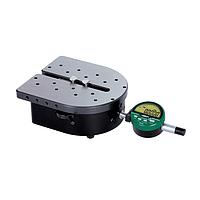
One representative product is the INSIZE 6848-145 Universal Comparison Measuring Bench. This type of bench is suited to dimensional comparison work where users need fine resolution and consistent repeatability during inspection. It supports external and internal diameter measurement, with the effective range depending on the measuring probes used.
From the available product data, this model offers very fine resolution and repeatability for precision-oriented checking. That makes it relevant for applications where users compare dimensions against a reference or zero point and need stable readings over a controlled range. In practical terms, this kind of equipment can be useful in part inspection routines where small dimensional differences matter and confidence in the reading is essential.
The role of INSIZE in industrial metrology workflows
INSIZE is a recognized name in measurement and inspection equipment, and its presence in this category is especially relevant for users looking for dimensional control tools in production and quality environments. In B2B purchasing, manufacturer familiarity often matters because it supports standardization across teams, simplifies training, and makes it easier to align tools with existing inspection practices.
When evaluating a measurement brand, buyers typically look beyond the headline range or resolution. They also consider whether the product family is suitable for recurring inspection routines, whether accessories or probe options are available for the intended task, and how well the instrument matches the company’s existing metrology process. For many organizations, that practical fit is just as important as the specification itself.
How this category fits into a broader automation ecosystem
Industrial measurement rarely operates in isolation. In many facilities, inspection data is part of a wider workflow that includes machine control, electrical protection, and visual verification. For example, dimensional or process checks may support decisions made at the control level, while complementary systems such as industrial cameras and accessories help with visual inspection or documentation in automated lines.
Similarly, the surrounding infrastructure matters. Stable machine operation and equipment safety influence how reliably measurements can be taken and applied. In some applications, supporting components such as circuit protection devices form part of the overall environment that keeps automation and testing systems running consistently. Looking at measurement as part of a connected industrial setup often leads to better long-term equipment choices.
Choosing the right solution for your application
A good starting point is to define the actual inspection objective: what needs to be measured, how often, by whom, and under what conditions. Once that is clear, it becomes easier to narrow the selection based on range, resolution, repeatability, and workflow suitability. This approach helps avoid buying tools that are technically capable on paper but inefficient in daily use.
For engineering, production, and QA teams, the best category choice is usually the one that balances practical usability with the required level of precision. If your application involves dimensional comparison, high-resolution inspection, or repeatable bench-based checks, reviewing the available products in this category can help identify equipment that aligns with your process rather than forcing the process to adapt to the tool.
Final considerations
Industrial measurement supports better decisions at every stage of operation, from setup and validation to maintenance and final inspection. Choosing suitable equipment can improve consistency, reduce uncertainty, and give teams clearer technical data when quality or performance is on the line.
As you explore this category, focus on the measurement task, the expected tolerance, and the broader workflow in which the instrument will be used. That makes it easier to select tools that deliver meaningful value in real industrial conditions, not just in specification tables.
Get exclusive volume discounts, bulk pricing updates, and new product alerts delivered directly to your inbox.
By subscribing, you agree to our Terms of Service and Privacy Policy.
Direct access to our certified experts