
PXI Controllers
When a PXI or PXI Express system is expected to handle demanding test, measurement, or automation workloads, the controller becomes a critical part of the overall platform. Processing power, communication bandwidth, operating environment, and expansion method all influence how smoothly a chassis integrates into lab validation, production test, or long-term system deployment.
This category brings together PXI Controllers and related remote control options from NI for engineers building modular test systems. Whether the goal is a high-performance embedded controller inside the chassis or an external host connection for distributed architectures, the available options support a wide range of PXI-based applications.
Why controller selection matters in a PXI system
A PXI platform is often chosen for its modularity, timing capabilities, and ability to combine multiple instrument functions in one chassis. The controller is what ties those resources together, managing software execution, data movement, and communication between modules and external systems.
In practice, controller choice affects more than boot performance. It can shape measurement throughput, user interface responsiveness, storage handling, and how well the system supports large data sets or synchronized test sequences. For applications that combine instruments such as oscilloscopes with switching, data acquisition, or RF modules, bandwidth and processor capability become especially important.
Embedded PXI controllers for integrated, self-contained systems
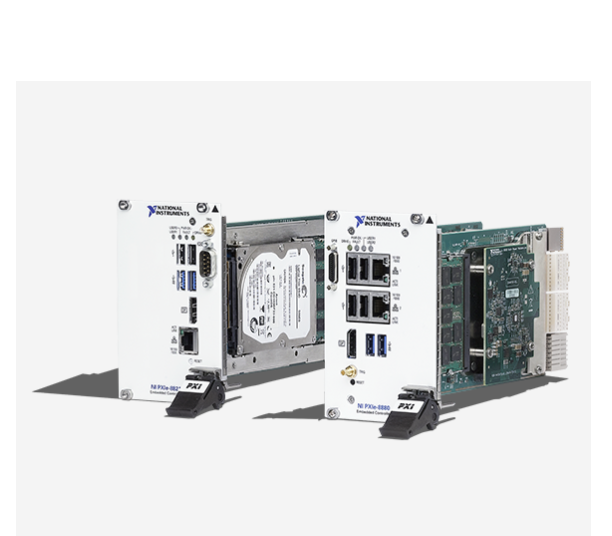
An embedded controller is typically the preferred option when a PXI chassis needs to operate as a compact and self-contained test station. This approach keeps the processing hardware inside the platform, simplifies deployment, and reduces dependency on an external PC in daily operation.
Examples in this category include the NI PXIe-8881 PXI Controller, available in Windows 10 64-bit and LabVIEW Real-Time configurations. Within the listed options, the PXIe-8881 family supports up to 24 GB/s maximum controller bandwidth and is offered with Xeon-based processing, making it suitable for systems that need strong compute performance for data-intensive or timing-sensitive workflows.
Selection between operating systems depends on application priorities. A Windows-based controller may fit development environments that require broad software compatibility and local user interaction, while a real-time configuration is commonly considered when deterministic behavior and tighter control over execution are part of the system design.
Remote control modules for flexible PXI architecture
Not every PXI system is built around an embedded controller. In many labs and automated stations, the chassis is controlled from an external computer using a remote control module. This architecture can be useful when the host PC already manages the application software, user interface, database access, or larger processing tasks.
NI offers several remote control paths in this category. The NI PXIe-8399 and NI PXIe-8398 support MXI-Express Gen3 x16 with 16 GB/s bandwidth, which makes them relevant for high-throughput PXI Express setups. The NI PXIe-8381 provides MXI-Express Gen2 x8 performance at 4 GB/s, while the NI PXIe-8301 uses Thunderbolt 3.0 for systems that benefit from a more PC-oriented external connection method.
Lower-bandwidth options such as the NI PXIe-8360, NI PXI-8360, and NI PXI-8368 remain useful where application demands are lighter or where legacy integration and physical media choice are part of the design constraints. Copper and fiber optic variants can also influence installation strategy, especially when distance, electrical isolation, or routing conditions matter.
External controllers and host-based expansion
For some PXI deployments, the ideal setup is neither a standard embedded controller nor a simple laptop connection. An external host controller can provide a dedicated computing platform for controlling one or more PXI systems while keeping processing resources outside the chassis.
The NI RMC-8356 External Controller for PXI is a good example of this role. Based on the listed configuration, it combines Xeon processing, DDR4 memory support, local storage, and a PCI Express 3.0 x16 slot to support PXI control in applications that need workstation-style resources in a rackmount format. This type of solution is often relevant in production environments, validation benches, and installations where serviceability or physical separation between compute hardware and instrumentation is preferred.
How to choose the right PXI controller
Controller selection usually starts with the software environment and workload profile. If the system must run locally in the chassis with minimal external hardware, an embedded controller is often the most direct approach. If the chassis is part of a broader test cell controlled by a host computer, a remote control module may be the better fit.
Bandwidth is another key consideration. High-speed mixed-instrument systems, large waveform capture, or rapid data streaming can benefit from newer MXI-Express Gen3 x16 solutions such as the PXIe-8399 or PXIe-8398. More modest applications may work well with lower-bandwidth interfaces, provided expected data transfer rates are aligned with actual system demand.
It is also useful to consider the rest of the PXI ecosystem. A platform used alongside switch modules, precision measurement hardware, or digital multimeters may prioritize determinism, synchronization, and software compatibility differently than a platform focused on high-volume waveform data. Matching the controller to the instrument mix helps avoid bottlenecks later in deployment.
Typical application scenarios
PXI controllers are widely used in automated test systems for electronics validation, semiconductor test support, aerospace and defense benches, and industrial R&D environments. In these settings, the controller must do more than simply start the chassis; it must support stable operation across instrument drivers, sequencing software, and long test runs.
In lab environments, users may prefer a Windows-based embedded controller for direct operation at the rack or bench. In manufacturing, an external control architecture may be more practical when a host PC coordinates multiple systems, databases, and operator interfaces. For advanced modular setups that also rely on precision sourcing, related categories such as Source Measurement Units can be part of the same NI-based test platform.
What this category helps you compare
This page is useful for comparing controller approaches rather than looking at processor speed alone. The more meaningful questions are whether the controller is embedded or remote, what communication standard it uses, how much bandwidth it can support, and which operating environment best matches the intended application.
Within the NI portfolio shown here, users can compare compact embedded options such as the PXIe-8881 family against host-connected modules like the PXIe-8399, PXIe-8398, PXIe-8381, PXIe-8301, and earlier MXI-based models. That makes the category relevant both for new PXI system design and for upgrades to existing installations.
Conclusion
The right PXI controller depends on how the full system is expected to run: as a standalone instrument platform, as a high-bandwidth extension of a host PC, or as part of a larger automated test architecture. By reviewing controller type, interface bandwidth, OS preference, and integration needs together, it becomes easier to narrow down the most appropriate option.
For teams building or expanding NI-based modular test systems, this category provides a practical starting point to evaluate embedded controllers, remote control modules, and external control hardware in one place.
Get exclusive volume discounts, bulk pricing updates, and new product alerts delivered directly to your inbox.
By subscribing, you agree to our Terms of Service and Privacy Policy.
Direct access to our certified experts