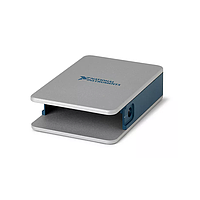
CompactDAQ Chassis
When measurement points are distributed across a machine, test bench, or industrial cell, a modular DAQ platform is often easier to scale than a fixed all-in-one device. CompactDAQ Chassis provide the hardware foundation for that approach, serving as the central platform that connects I/O modules, manages communication to the host system, and supports reliable data acquisition in lab, validation, and industrial environments.
Within the NI ecosystem, CompactDAQ chassis are available in different slot counts, bus interfaces, and environmental ratings. That makes it possible to build systems for anything from a small single-module setup to a larger multi-sensor configuration that combines analog, digital, and synchronized measurements in one platform.
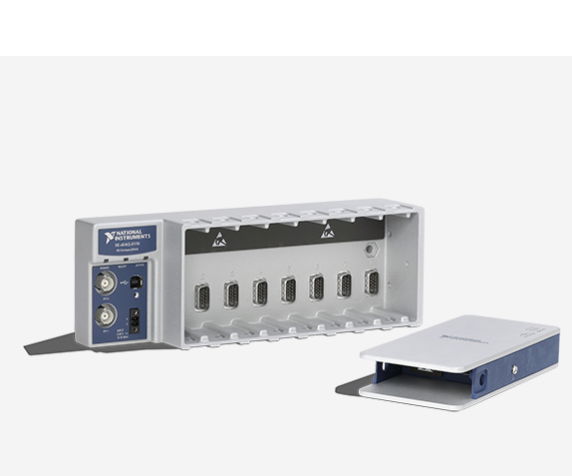
What a CompactDAQ chassis does in a modular measurement system
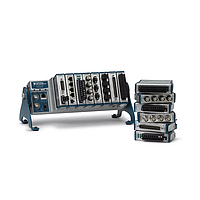
A chassis is the core of a CompactDAQ system. It houses the measurement modules, provides power and communication, and determines practical system capabilities such as slot capacity, connectivity type, triggering support, and in some models, synchronization between modules or distributed systems.
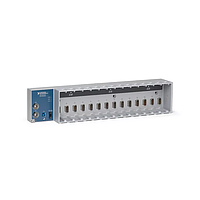
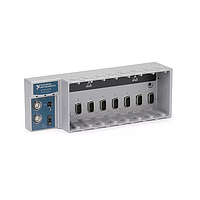
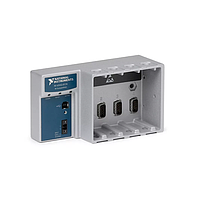
In real applications, this matters because the chassis affects how easily a system can be expanded and how well it fits the installation environment. A compact 1-slot platform may be enough for a focused measurement point, while 4-slot, 8-slot, or even 14-slot options are better suited to mixed I/O systems that need room for multiple signal types and future growth.
Available configurations for different system sizes
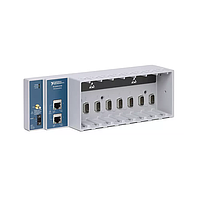
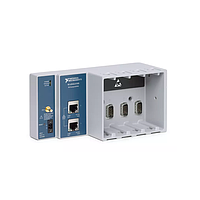
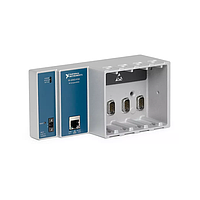
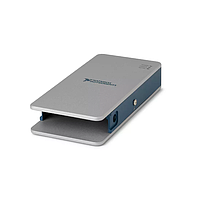
This category includes chassis in several form factors, from single-slot units such as the NI cDAQ-9181 to mid-range 4-slot models like the NI cDAQ-9184 and NI cDAQ-9185, up to 8-slot platforms including the NI cDAQ-9188 and NI cDAQ-9189. For larger USB-based systems, the NI cDAQ-9179 offers a 14-slot option for higher channel density in one chassis.
The right slot count usually depends on how many module types need to be installed at the same time. A smaller chassis can simplify remote or dedicated measurement nodes, while larger chassis are more practical for applications that combine sensor acquisition, actuator interfacing, and status monitoring in the same architecture.
If your project also depends on mixed signal handling, it can be helpful to review related options for multifunction I/O when planning the overall system structure.
Ethernet and USB chassis: choosing the right connection method
One of the main selection points in this range is the host interface. Ethernet-based chassis such as the NI cDAQ-9181, cDAQ-9185, cDAQ-9188, and cDAQ-9189 are well suited to distributed installations where the DAQ hardware needs to sit closer to the sensors or machine under test, while the controller or PC is located elsewhere on the network.
USB-based models such as the NI cDAQ-9174, cDAQ-9178, and cDAQ-9179 are often selected for bench testing, portable validation setups, or workstation-based acquisition where direct local connection is preferred. In practice, the choice is less about which interface is universally better and more about cable distance, panel layout, access to the host computer, and the level of system distribution required.
For broader system design, users working with networked equipment may also want to explore industrial communication buses as part of the surrounding automation architecture.
Synchronization, triggering, and control considerations
Not every chassis is intended for the same timing requirements. Some models in this category include synchronization support and onboard triggering, which can be important in applications where multiple modules must acquire data with coordinated timing. This is especially relevant in machine monitoring, transient capture, hardware-in-the-loop style validation, and multi-channel test setups.
For example, the NI cDAQ-9185 and NI cDAQ-9189 support synchronization and onboard trigger capabilities, making them suitable for more timing-sensitive modular systems. Other models such as the NI cDAQ-9184 or cDAQ-9181 are better aligned with simpler or more localized acquisition tasks where advanced synchronization is not the primary requirement.
When the application includes discrete status signals, control lines, or machine-state interfacing, related signal modules in digital I/O can help complete the system around the chassis.
Environmental suitability and industrial deployment
Chassis selection is also influenced by installation conditions. Several models listed here support operation down to -40 °C and up to 70 °C, which is valuable in harsher industrial or outdoor-adjacent environments where standard lab-only hardware may not be sufficient. This wider operating range can support deployment near process equipment, inside industrial panels, or in demanding validation setups.
Some variants are also available with conformal coating. In general terms, this type of protection can help improve resistance in environments where humidity, dust, or contamination are considerations. Examples in this category include conformal-coated versions of the NI cDAQ-9189, cDAQ-9185, and cDAQ-9181, which may be relevant when long-term stability in tougher conditions is part of the design brief.
Typical signal applications built around CompactDAQ
A CompactDAQ chassis is usually chosen as part of a broader measurement chain rather than as a standalone endpoint. Depending on the installed modules, the system can be configured for sensor voltage monitoring, current measurement, digital status capture, or mixed acquisition tasks that combine multiple signal domains in one chassis.
That modularity is one of the key reasons these platforms are widely used in engineering and industrial settings. Instead of replacing the entire system when requirements evolve, users can often reconfigure or expand the installed module set around the existing chassis, provided the slot count and interface strategy remain appropriate.
For signal-specific expansion, related categories such as voltage measurement can provide additional context when matching chassis capacity to expected channel types.
How to choose the right CompactDAQ chassis
A practical selection process starts with four questions: how many modules are needed, where the chassis will be installed, how it should connect to the host system, and whether synchronized timing is necessary. These factors usually narrow the field quickly between 1-slot, 4-slot, 8-slot, and 14-slot models, as well as between Ethernet and USB platforms.
It is also worth considering environmental rating early in the project, especially for machine-mounted or industrial deployments. If the system may be exposed to temperature extremes or harsher ambient conditions, a wider operating range or conformal-coated version can be more suitable than a standard indoor configuration.
Finally, think beyond the initial channel count. A chassis is the backbone of the modular system, so choosing a platform with appropriate headroom can make later expansion easier without redesigning the whole acquisition architecture.
Building a scalable NI data acquisition platform
This category brings together NI CompactDAQ chassis for a range of modular data acquisition and control needs, from compact single-slot Ethernet units to higher-capacity USB and Ethernet systems. The differences in slot count, interface, synchronization support, triggering, and environmental protection give engineers flexibility to match the hardware to real installation and measurement requirements.
If you are comparing options for a new system or updating an existing test and measurement setup, the most effective choice is usually the one that aligns with the signal mix, deployment environment, and expected future expansion. A well-matched chassis creates a stronger foundation for the rest of the DAQ system and helps keep integration more straightforward as the application grows.
Get exclusive volume discounts, bulk pricing updates, and new product alerts delivered directly to your inbox.
By subscribing, you agree to our Terms of Service and Privacy Policy.
Direct access to our certified experts