Air Curtain
Controlling airborne contamination at doorways and open access points is a practical challenge in many clean production and controlled-environment facilities. A well-designed air curtain helps create a stable air barrier that reduces the transfer of dust, insects, and unconditioned air between zones, supporting cleaner workflows without interrupting material or personnel movement.
In clean room support areas, packaging zones, electronics assembly, and other industrial spaces, this type of equipment is often used to improve environmental separation where a physical door may not be ideal. It can also complement broader contamination-control measures by helping maintain cleaner transitions between adjacent spaces.
Why air curtains matter in controlled environments
An air curtain works by generating a continuous, high-velocity sheet of air across an opening. This airflow acts as a protective air barrier, helping limit the entry of dust, flying insects, and outside air while allowing people, carts, or products to pass through more easily than with constantly opened doors.
In facilities where cleanliness and process stability matter, reducing contamination at entrances can support both product quality and housekeeping efficiency. Air curtains are particularly relevant when operators need frequent access between rooms, or when logistics traffic makes conventional door control less practical.
Typical applications for air curtain systems
Air curtains are used across a range of B2B environments, especially where cleanliness and airflow control are important. Common applications include clean room support areas, electronics manufacturing, pharmaceutical preparation areas, food-related processing support zones, warehouses with hygiene requirements, and industrial rooms that need to reduce insect intrusion.
They are also useful at transition points between conditioned and non-conditioned spaces. In these cases, the equipment can help reduce the direct exchange of air, which may contribute to more stable indoor conditions and a more controlled working environment.
Key considerations when selecting an air curtain
The right configuration depends on the opening size, installation position, expected traffic, and the cleanliness objective of the area. Buyers typically review factors such as air velocity, total air volume, power supply, body dimensions, and construction materials, especially when the equipment will be installed in industrial or clean-support settings.
It is also important to consider whether the unit is intended mainly for insect control, dust reduction, or separation between process areas. For wider openings, dimensions and throw performance become especially important, since the air barrier needs to remain effective across the full doorway width and height.
Featured example from Airtech
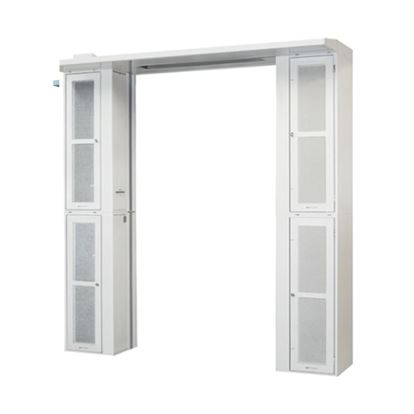
One representative option in this category is the Airtech AAC-20250C Air Curtain, designed for large openings with a 3000 x 850 x 2600 mm overall size. Based on the provided product data, this model delivers substantial airflow and includes high- and low-velocity sides, making it suitable for applications where a strong and consistent air barrier is needed.
The unit uses an AC380V, 3-phase, 50Hz power supply and features a steel body with static powder coating. For buyers comparing equipment across projects, these details help indicate the installation environment, utility requirements, and overall build orientation expected in industrial clean-area applications.
How air curtains fit into a clean room workflow
An air curtain is usually most effective when it is treated as part of a broader contamination-control strategy rather than as a standalone solution. In practice, facilities may combine it with entry management, routine cleaning tools, and local clean-air equipment depending on process sensitivity and room classification goals.
For example, doorway protection can be complemented by air shower systems in personnel entry paths, or by clean bench equipment where localized clean airflow is required for specific operations. In production areas that still depend on manual surface care, appropriate clean room cleaning accessories also remain relevant.
Manufacturer context and product ecosystem
This category includes solutions from Airtech, a recognized name within clean room and controlled-environment equipment. When evaluating a manufacturer in this segment, buyers often look beyond a single unit and consider whether the broader product ecosystem supports future expansion, maintenance consistency, and standardization across multiple rooms or sites.
That is especially useful for projects where airflow control equipment, clean-area furniture, and containment products need to work together in a coordinated layout. A consistent sourcing approach can simplify both technical review and long-term facility planning.
Practical buying guidance for industrial users
Before selecting a model, it is worth confirming the door opening dimensions, mounting constraints, electrical availability, and the exact contamination risks present at the installation point. A unit intended for insect prevention at a loading interface may be assessed differently from one used to reduce dust transfer between controlled work areas.
It is also helpful to review traffic intensity, nearby ventilation conditions, and whether the opening is exposed to pressure differences or drafts. These practical details often have a direct effect on how well the air barrier performs in day-to-day operation.
Conclusion
Choosing the right air curtain is less about adding another doorway device and more about improving environmental separation where movement cannot stop. For clean room support operations, industrial hygiene control, and contamination-sensitive workflows, the category offers useful options for reducing airborne transfer at critical access points.
By comparing opening size, airflow requirements, installation conditions, and the surrounding clean-area equipment, buyers can identify a solution that fits both the site layout and the intended level of protection.
Get exclusive volume discounts, bulk pricing updates, and new product alerts delivered directly to your inbox.
By subscribing, you agree to our Terms of Service and Privacy Policy.
Direct access to our certified experts